Why Choose a Hatchback OR an SUV When You Can Have This?
Young car buyers are tired of choosing between two flawed options: hatchbacks that lack versatility or SUVs that feel bloated in cities. The new Ford Puma has emerged as a game-changer, blurring the lines between these categories with a design that borrows the best from both. Labeled a "crossover coupe" by marketers, it raises the question: is this vehicle a tall hatchback, a compact SUV, or something entirely new—one that solves the compromises plaguing modern urban mobility? By dissecting its dimensions, driving dynamics, utility, and design philosophy, we uncover why the Puma isn’t just a trend—it’s a reimagining of what young buyers need, merging practicality with the agility of a hatchback and the presence of an SUV.
Dimensions and driving dynamics reveal the Puma’s hatchback DNA with strategic SUV upgrades. At 164.8 inches long, it’s nearly identical to the Ford Fiesta hatchback (160.1 inches) and 10 inches shorter than the Ford EcoSport subcompact SUV (173.5 inches). Its 34.8-foot turning circle matches the Fiesta’s, letting it weave through tight city streets and squeeze into parallel parking spots that leave small SUVs struggling. Yet the Puma’s 7.9 inches of ground clearance—2.5 inches higher than the Fiesta’s and just 0.5 inches less than the EcoSport’s—grants it the ability to tackle potholes, gravel driveways, or snowy roads without scraping. Think of it as a hatchback standing on sturdy boots: it retains the nimble handling of a compact car (thanks to its low center of gravity relative to SUVs) while adding the confidence of elevated clearance. Young drivers who want city agility without sacrificing weekend adventure find this balance irresistible.
Utility and space, the SUV’s traditional strengths, are packed into the Puma’s hatchback-sized footprint. It offers 17.1 cubic feet of cargo space behind the rear seats—surpassing the Fiesta’s 14.9 cubic feet and nearly matching the EcoSport’s 19.2 cubic feet. The Puma’s clever "Megabox" storage compartment—an 8.8-cubic-foot waterproof bin under the cargo floor—adds versatility for wet gear, groceries, or small luggage, a feature no traditional hatchback can match. Rear legroom (35.9 inches) is comparable to the EcoSport (36.7 inches) and more generous than the Fiesta (33.2 inches), comfortably fitting young adults or weekend passengers. The Puma’s roof rails (standard on higher trims) let users attach bike racks or cargo boxes for longer trips, extending its utility without the bulk of a full-size SUV. For young buyers who split time between commuting, socializing, and outdoor activities, this "right-sized" practicality beats the one-note nature of hatchbacks or SUVs.
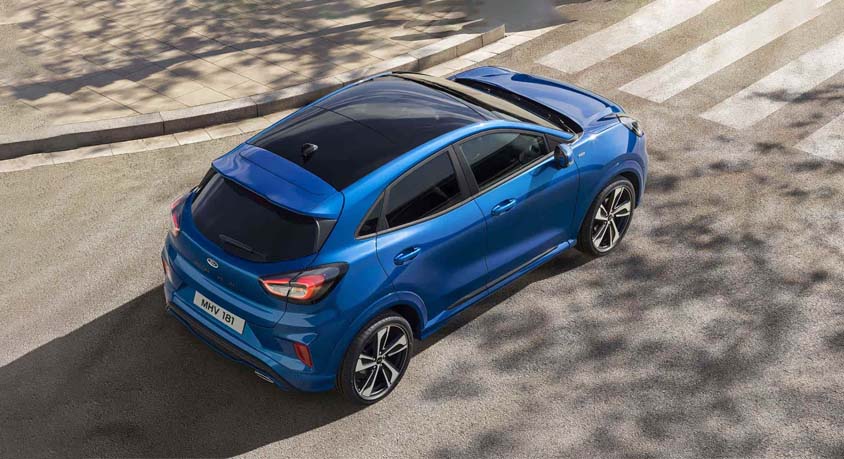
Design and appeal, tailored to younger tastes, blend hatchback sportiness with SUV ruggedness. The Puma features a sloping roofline, sculpted wheel arches, and a bold grille that echoes the Fiesta’s sporty vibe, while black plastic cladding around the wheel wells and lower body adds the "off-road-ready" aesthetic that young buyers associate with adventure. Inside, it retains a driver-focused cockpit with a 12.3-inch digital instrument cluster and 8-inch touchscreen—tech-forward features that match the expectations of digitally native buyers—paired with durable materials that withstand the wear and tear of active lifestyles. Unlike boxy small SUVs, the Puma’s coupe-like profile avoids the "mom car" stigma, appealing to young professionals who want a vehicle that feels personal, not practical by default.
The Puma’s success lies in its refusal to fit a single category—it’s a response to young buyers who reject compromise. Hatchbacks feel limiting, SUVs feel cumbersome, but the Puma delivers city agility, adventure capability, and everyday utility in one package. Its fuel efficiency (30 MPG city/37 MPG highway) outperforms most small SUVs, aligning with young buyers’ eco-conscious values without forcing them into electric vehicles they may not be ready for. For a generation that values versatility, style, and affordability, the Puma isn’t just a hybrid of two car types—it’s a hybrid of their conflicting needs.
The Ford Puma isn’t merely a hatchback or an SUV—it’s the best of both, engineered for the way young people actually live. Most carmakers force buyers to choose between categories, but the Puma breaks the mold by addressing the real-world demands of urban youth. It proves that blurring the lines isn’t a flaw—it’s a feature, one that resonates with buyers who want their vehicle to keep up with their multifaceted lives. For young drivers tired of choosing between agility and utility, the Puma isn’t just a new option—it’s the answer they’ve been waiting for.
latest news

- Dec,28,2025
- What If the Loudest Thing About a 155 mph Car Was Your Heartbeat?
- Automobile
- Most drivers accept road noise as an unavoidable side effect of speed—wind howling past mirror...
- Dec,26,2025
- The Hatchback vs. SUV Debate Is Over. Here’s Who Should Buy Each
- Automobile
- Car buyers often follow trends instead of their daily routines, picking an SUV for its perceived pra...
- Dec,24,2025
- Why the Hot Hatch (Still) Humiliates the Hot SUV
- Automobile
- The performance car market is trapped in a misperception: that taller ride heights and SUV badging c...
- Dec,22,2025
- Most People Think EVs Are Greener—But RAV4 Hybrid vs. ID.3 Truth Shocks
- Automobile
- Eco-conscious car buyers often default to electric vehicles (EVs) as the "greener" choice, assuming ...