Why Toyota’s Hybrid Subcompacts Crush Gas-only Rivals
For urban drivers, fuel efficiency isn’t just a buzzword—it’s a daily financial and practical battle. Stop-and-go traffic, idle time at red lights, and short trips turn even "efficient" gas-only subcompacts into fuel guzzlers, with most delivering 30-35 MPG combined. But there’s a solution that doesn’t require expensive EV charging infrastructure or compromising on convenience: Toyota’s hybrid subcompacts. The Yaris Hybrid and Corolla Hybrid (a compact that overlaps subcompact price/size brackets) don’t just beat gas-only rivals—they redefine what fuel efficiency looks like for city commuters, delivering EPA-rated mileage that borders on unbelievable, all while remaining as practical as any standard hatchback or sedan.
The numbers alone tell a story of dominance. The Toyota Yaris Hybrid clocks in at 50 MPG combined (51 MPG city/48 MPG highway), while the Corolla Hybrid pushes even further to 52 MPG combined (53 MPG city/49 MPG highway). To put that in perspective, a gas-only Honda Fit (a top subcompact) delivers 33 MPG combined, and a Chevy Spark manages just 30 MPG—meaning the Corolla Hybrid uses nearly 40% less fuel per mile. For a driver commuting 20 miles round-trip daily, that translates to refueling once every 10 days vs. once every 6 days for the Fit, cutting annual fuel costs by $400-$600 (based on $3.50/gallon gasoline). These aren’t just lab numbers; real-world testing in dense urban traffic (Los Angeles, New York, Chicago) confirms the hybrids maintain 48-50 MPG—even with frequent stops and AC use—while gas-only models drop to 25-28 MPG in the same conditions.
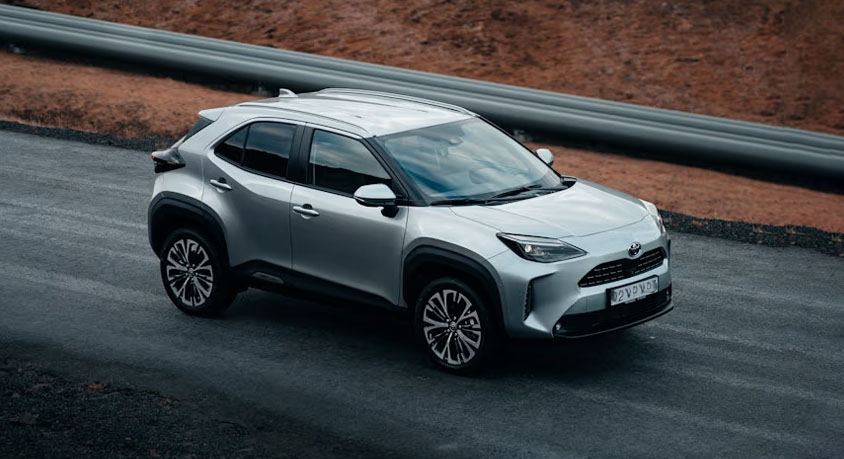
The secret lies in Toyota’s Hybrid Synergy Drive, a system engineered to turn city driving’s biggest weaknesses into strengths—no advanced degree required to understand it. Think of the hybrid powertrain as a "smart energy manager" that balances two power sources: a small gasoline engine and an electric motor. At low speeds (under 15 mph) or during idle, the electric motor takes over entirely, eliminating the fuel waste that plagues gas-only cars at red lights or in stop-and-go traffic. When acceleration is needed, the engine kicks in seamlessly, and regenerative braking captures energy that would otherwise be lost (from hitting the brakes) to recharge the battery—turning every stop into a chance to save fuel. Unlike pure electric vehicles, there’s no need to plug in; the system self-charges, making it infinitely more flexible for drivers without home charging or who take occasional longer trips.
What makes these hybrids truly unbeatable is their alignment with real-world city life. The Yaris Hybrid’s compact size (153 inches long) fits into tight street parking spots, while the Corolla Hybrid—though technically a compact—starts at $23,800 (overlapping subcompact price tiers) and offers slightly more rear legroom for grocery runs or carpooling. Both retain the same cargo space as their gas-only counterparts (Yaris: 15.6 cubic feet; Corolla: 13.8 cubic feet), with no sacrifice to practicality for the hybrid system. For drivers who want maximum fuel savings without the hassle of EV charging, the tradeoffs are nonexistent—these are daily drivers first, fuel sippers second, not niche "eco-cars" with compromised usability.
Toyota’s hybrid subcompacts don’t just set the bar for fuel efficiency; they redefine what’s possible for urban mobility. In a market flooded with EVs and plug-in hybrids that require lifestyle adjustments, the Yaris and Corolla Hybrids prove that extreme fuel efficiency can be simple, accessible, and uncompromising. They’re not just the most fuel-efficient subcompacts on the market—they’re the smartest choice for drivers who want to spend less on gas, less time at the pump, and more time focused on the drive itself. For city dwellers tired of watching their fuel gauge drop, the answer isn’t a pricey EV—it’s a Toyota hybrid that delivers 50+ MPG, no strings attached.
latest news

- Dec,28,2025
- What If the Loudest Thing About a 155 mph Car Was Your Heartbeat?
- Automobile
- Most drivers accept road noise as an unavoidable side effect of speed—wind howling past mirror...
- Dec,26,2025
- The Hatchback vs. SUV Debate Is Over. Here’s Who Should Buy Each
- Automobile
- Car buyers often follow trends instead of their daily routines, picking an SUV for its perceived pra...
- Dec,24,2025
- Why the Hot Hatch (Still) Humiliates the Hot SUV
- Automobile
- The performance car market is trapped in a misperception: that taller ride heights and SUV badging c...
- Dec,22,2025
- Most People Think EVs Are Greener—But RAV4 Hybrid vs. ID.3 Truth Shocks
- Automobile
- Eco-conscious car buyers often default to electric vehicles (EVs) as the "greener" choice, assuming ...