An Suv That Drives Like A Sports Car
The SUV world operates on an unspoken rule: size and utility demand compromise on speed and agility. A 5,500-pound family hauler isn’t supposed to outpace sports cars on a track, let alone set records at the Nürburgring. But Porsche has never been one to respect unwritten rules. The Cayenne Turbo GT doesn’t just blur the line between SUV and sports car—it erases it entirely. This isn’t a "fast for an SUV" novelty; it’s a track-capable machine that happens to have four doors, a spacious trunk, and room for groceries. To understand its magic, we must look beyond the specs and into the engineering choices that turn a practical vehicle into a Nürburgring conqueror.
Performance data tells the first part of the story, and it’s nothing short of shocking. The Cayenne Turbo GT’s 4.0L twin-turbo V8 cranks out 650 hp and 626 lb-ft of torque, hitting 60 mph in 3.1 seconds and topping out at 186 mph—faster than a BMW M4 Competition and Chevrolet Corvette Stingray. But the real proof lies in its Nürburgring Nordschleife lap time: 7 minutes and 38.9 seconds, one of the fastest ever recorded for a production SUV. This isn’t just a number; it’s a testament to power delivery that’s both brutal and precise. The 8-speed PDK transmission shifts in 100 milliseconds in Sport Plus mode, like a sprinter exploding out of the blocks, while the all-wheel-drive system sends 60% of power to the rear wheels for a rear-biased feel that mimics Porsche’s 911. Unlike most high-performance SUVs, which feel like they’re "fighting their weight," the Cayenne Turbo GT uses its heft as a tool—planted and stable at triple-digit speeds.
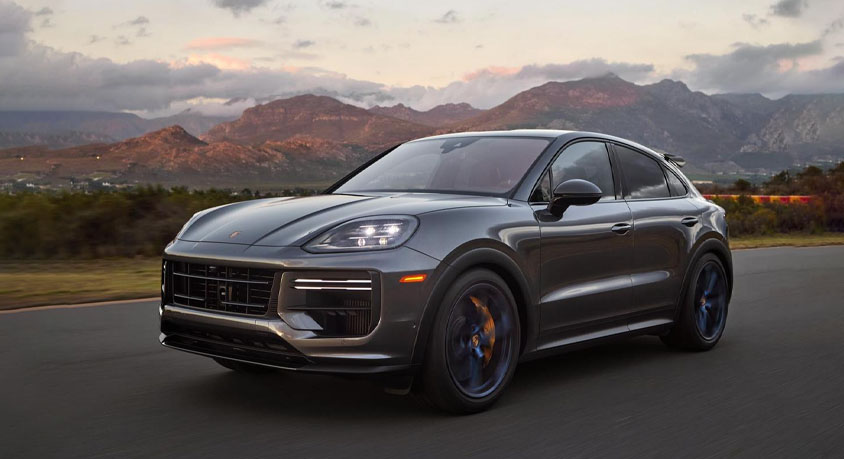
Chassis and suspension engineering are where the Cayenne Turbo GT defies physics. Its Porsche Active Suspension Management (PASM) system acts like an electronic brain for the shocks, adjusting damping 100 times per second to eliminate body roll. Pair that with rear-axle steering—turning the rear wheels opposite the front at low speeds and in the same direction at high speeds—and this 16.7-foot-long SUV handles like a much smaller car. At 30 mph, the rear wheels pivot up to 4.5 degrees, shrinking its turning circle to 38.7 feet (nearly matching a Porsche Macan), while at 80 mph, they align with the front wheels to enhance stability during lane changes. It’s like teaching a heavyweight boxer to dance—every movement is controlled, precise, and unexpected for its size.
Steering and braking complete the track-ready package. The Cayenne Turbo GT’s steering is pure Porsche: direct, communicative, and free of artificial feedback. It transmits road texture to the driver’s hands like a conversation, letting you feel every pebble and camber change—critical for pushing limits on a track. The brakes are equally impressive: 16.5-inch carbon-ceramic front discs (the largest ever fitted to a Cayenne) stop the SUV from 60 mph in just 104 feet, with zero fade after repeated hard stops. This isn’t just stopping power; it’s confidence—the kind that lets you brake later, carry more speed through corners, and trust the vehicle to handle whatever the track throws at it.
The sensory experience ties it all together, erasing any doubt that this is a true performance machine. Its sport exhaust system belts out a guttural V8 roar that echoes through canyons, with a crackle on overrun that’s pure sports car theater—no muted "luxury SUV" sound deadening here. Inside, the Alcantara-wrapped GT steering wheel, bucket seats with aggressive bolsters, and carbon-fiber trim create a cockpit that feels more 911 than Cayenne. Even the infotainment system prioritizes track use, with a "Track Precision App" that records lap times, speed, and g-forces—turning every drive into a data-driven performance test.
The Cayenne Turbo GT isn’t a compromise; it’s a revelation. It proves that an SUV can be both practical and track-capable, without sacrificing either. This isn’t just a win for Porsche—it’s a redefinition of what an SUV can be. For enthusiasts who refuse to choose between family utility and driving passion, it’s the ultimate answer. For the rest of the industry, it’s a challenge: to stop treating "SUV performance" as an oxymoron and start building vehicles that honor the thrill of driving, no matter the body style. The Cayenne Turbo GT doesn’t just shame sports cars on the track—it makes them question their own relevance.
latest news

- Dec,28,2025
- What If the Loudest Thing About a 155 mph Car Was Your Heartbeat?
- Automobile
- Most drivers accept road noise as an unavoidable side effect of speed—wind howling past mirror...
- Dec,26,2025
- The Hatchback vs. SUV Debate Is Over. Here’s Who Should Buy Each
- Automobile
- Car buyers often follow trends instead of their daily routines, picking an SUV for its perceived pra...
- Dec,24,2025
- Why the Hot Hatch (Still) Humiliates the Hot SUV
- Automobile
- The performance car market is trapped in a misperception: that taller ride heights and SUV badging c...
- Dec,22,2025
- Most People Think EVs Are Greener—But RAV4 Hybrid vs. ID.3 Truth Shocks
- Automobile
- Eco-conscious car buyers often default to electric vehicles (EVs) as the "greener" choice, assuming ...